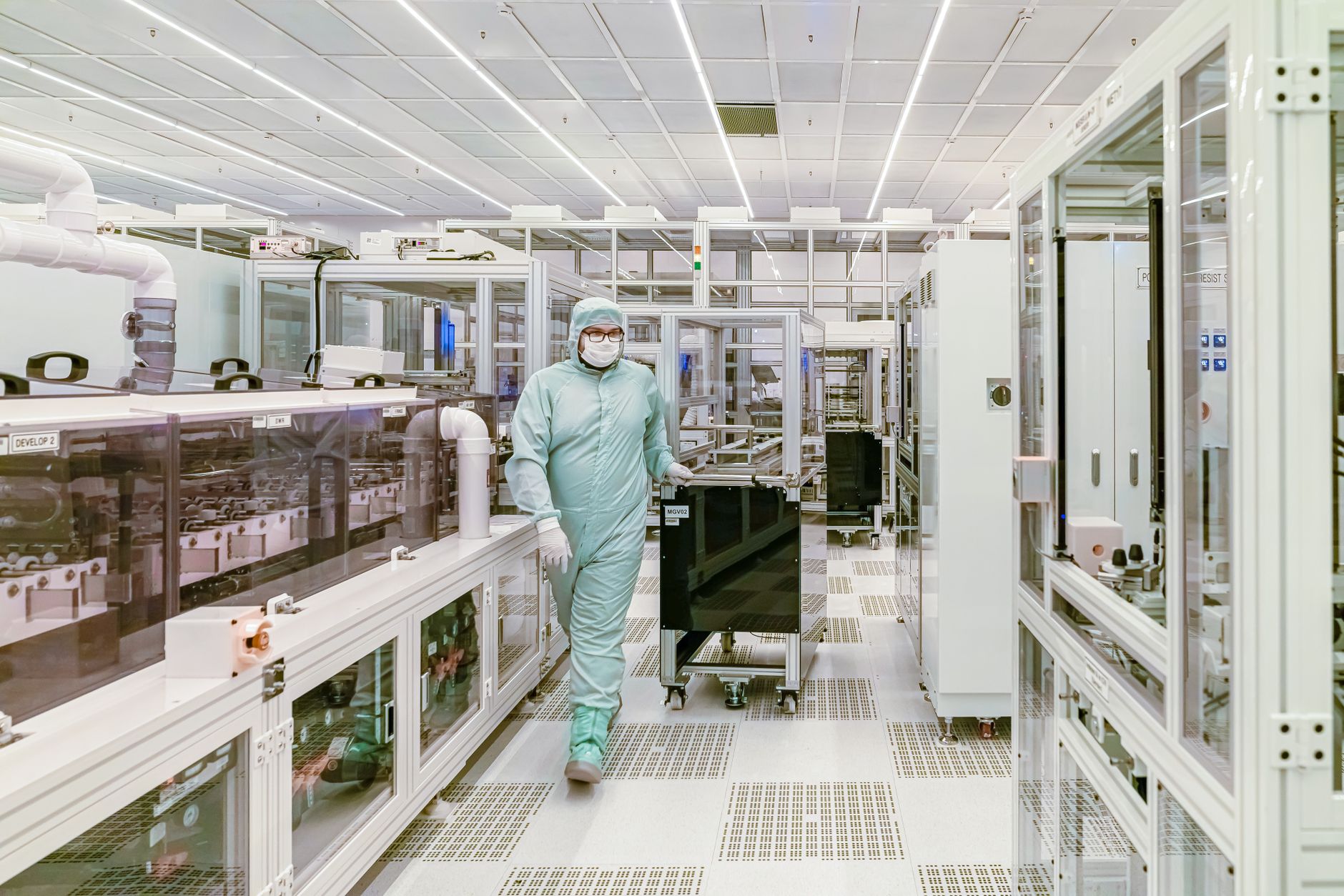
Dholera's semiconductor ecosystem is anchored by the Tata Electronics and PSMC fab, approved by the Union Cabinet on 29 February 2024 under the India Semiconductor Mission with an investment of Rs 91,000 crore and a planned capacity of up to 50,000 wafers per month at a 300mm fab. As of May 2026 civil work was about 50 percent complete, and the first chip is targeted for 2026 to 2027, a target with no source confirming a chip produced. A single large fab tends to pull in suppliers, materials firms, equipment servicing and ancillaries around it, which is how an ecosystem forms. Total jobs are quoted at more than 20,000 direct and indirect for this fab, with a multi-fab vision of about 100,000 stated as a target.
When people talk about Dholera changing India's manufacturing map, the semiconductor fab is what they mean. A single large chip fab does not sit alone. It tends to draw in a web of suppliers, materials firms, equipment servicing, gas and chemical providers, and ancillary manufacturers, which together form what is called a semiconductor ecosystem. This entry explains the anchor fab using only sourced figures, then walks through what an ecosystem around it could realistically mean, while being careful to label targets and aspirations as exactly that. No chip has been confirmed as produced yet.
DholeraPulse is an independent intelligence desk. It does not sell plots and is neutral on every company named here. The aim is to explain, not to hype.
The anchor: the Tata-PSMC fab
The ecosystem starts with one project. Tata Electronics, with Taiwan's Powerchip Semiconductor Manufacturing Corporation (PSMC) as technology partner, is building India's fab in Dholera through the entity Tata Semiconductor Manufacturing Pvt Ltd. The Union Cabinet approved it on 29 February 2024 under the India Semiconductor Mission. The investment is Rs 91,000 crore, roughly US$11 billion, and the PIB Fiscal Support Agreement cites Rs 91,526 crore. Planned capacity is up to 50,000 wafers per month at a 300mm fab. Its process nodes are mature and specialty, listed as 28, 40, 55, 90 and 110 nm, and its product mix covers power-management ICs, display drivers, microcontrollers and high-performance computing logic. The India Semiconductor Mission covers 50 percent of eligible cost, and the Fiscal Support Agreement was signed on 5 March 2025. For the project detail, see the Dholera semiconductor fab entry.
Where the fab stands in 2026
The fab is under construction, not yet producing. Ground-breaking was in March 2024, and civil work was about 50 percent complete by May 2026 after a late-2025 redesign to suit the soil. An MoU with ASML for lithography was reported on 17 May 2026. The first chip is targeted for 2026 to 2027, but this is a target and no source confirms a chip has been produced. That distinction matters for anyone sizing the ecosystem: the anchor is being built, and the suppliers and ancillaries that would cluster around it largely follow the fab reaching production, not its approval.
What a semiconductor ecosystem actually includes
A fab is the anchor tenant of a much larger supply web. Around a working fab you typically see several layers of activity, each a potential business and employer in the region:
- Materials and consumables: ultra-pure chemicals, specialty gases, photoresists, silicon wafers and packaging materials that a fab consumes continuously.
- Equipment and tools: lithography, etch, deposition and metrology systems, plus the field engineers who install and service them. The reported ASML lithography MoU sits in this layer.
- Assembly, testing and packaging: back-end operations that turn finished wafers into usable chips, often located near the fab.
- Utilities at industrial grade: reliable power, ultra-pure water, and specialty gas supply, which is one reason Dholera's trunk infrastructure and solar power matter.
- Support services: logistics, cleanroom maintenance, calibration, and specialised construction and facilities firms.
- Skilling and talent: engineering and technician training pipelines to staff the fab and its suppliers.
None of these are confirmed in Dholera at scale yet. They are the categories that historically cluster around a fab once it runs. The presence of the anchor is what makes such clustering plausible, which is precisely why a single fab is treated as ecosystem-forming rather than just one factory.
Jobs: what the numbers say and do not say
On employment, stay precise. The Tata fab's own figure is more than 20,000 direct and indirect jobs, and this is a target. A broader multi-fab vision cites about 100,000, also a target and dependent on additional fabs that are not committed the way this one is. Beyond that, a wider SIR-level total investment or GDP figure is not reliably sourced, and Dholera's headline of more than 800,000 SIR-wide jobs at full development is a long-range target, not a current count. So the honest framing is: one fab, more than 20,000 targeted jobs, with larger numbers being aspirations layered on top.
| Ecosystem figure | Value | Status |
|---|---|---|
| Fab investment | Rs 91,000 cr (PIB cites Rs 91,526 cr) | Committed, approved 2024 |
| Capacity | Up to 50,000 wafers/month, 300mm | Planned |
| Jobs, this fab | More than 20,000 direct + indirect | Target |
| Jobs, multi-fab vision | About 100,000 | Target, additional fabs not committed |
| First chip | 2026 to 2027 | Target, none confirmed produced |
| SIR-wide jobs | More than 800,000 at full development | Long-range target |
Why Dholera was chosen to host it
A fab needs three things in abundance: land, power and water, all at industrial reliability. Dholera offers a large greenfield canvas with trunk infrastructure already built in the Activation Area, a nearby solar park with about 300 MW commissioned and a 5,000 MW long-range target, and planned water infrastructure including a treatment plant of about 50 MLD. It is also the largest node of the Delhi-Mumbai Industrial Corridor, with the operational Ahmedabad-Dholera Expressway and an airport under construction about 20 km away for the movement of people and high-value goods. These are the conditions an ecosystem needs to take root. See smart-city utilities and the solar park.
The collapsed project, for context
It helps to remember that not every chip announcement in Dholera has held. A Vedanta and Foxconn joint venture signed an MoU with Gujarat in September 2022, widely cited at about US$19.5 billion, but Foxconn withdrew on 10 July 2023 and nothing was built. That US$19.5 billion was a joint-venture project value, not committed capital, and should not be counted as investment. It is history, not an active part of the ecosystem. The active anchor is the Tata-PSMC fab. Keeping the two separate is part of reading Dholera honestly.
Frequently asked questions
What anchors Dholera's semiconductor ecosystem?
Has Dholera produced a semiconductor chip yet?
How many jobs will the semiconductor ecosystem create?
What does a semiconductor ecosystem include beyond the fab?
Why was Dholera chosen for the fab?
What happened to the Vedanta-Foxconn project?
DholeraPulse. (2026). Dholera's Semiconductor Ecosystem: The Tata-PSMC Fab as an Anchor. Retrieved 22 July 2026, from https://dholerapulse.com/dholera-semiconductor-ecosystemSources & references
- DholeraPulse Fact Pack, 2026 (Tata-PSMC fab: Cabinet approval 29 Feb 2024, ISM, Rs 91,000 cr / PIB Rs 91,526 cr, up to 50,000 wafers/month 300mm, nodes 28/40/55/90/110 nm, ISM 50% eligible cost, Fiscal Support Agreement 5 Mar 2025, ground-breaking Mar 2024, ~50% civil May 2026, ASML MoU 17 May 2026, first chip target 2026-27, jobs >20,000 direct+indirect, multi-fab vision ~100,000; Vedanta-Foxconn MoU Sept 2022 ~US$19.5B, Foxconn withdrew 10 Jul 2023)
- DholeraPulse entries: Dholera semiconductor fab, smart-city utilities, solar park
- PIB PRID 2108602 (ISM-Tata); tata.com and tataelectronics.com; Tom's Hardware (ASML-Tata MoU 2026)
DholeraPulse labels facts by confidence. Figures marked reported or target come from press or announcements and may change; verify anything time sensitive against the official source before acting.